
ADU Builders: Repair or Replace? How Los Angeles Homeowners Decide
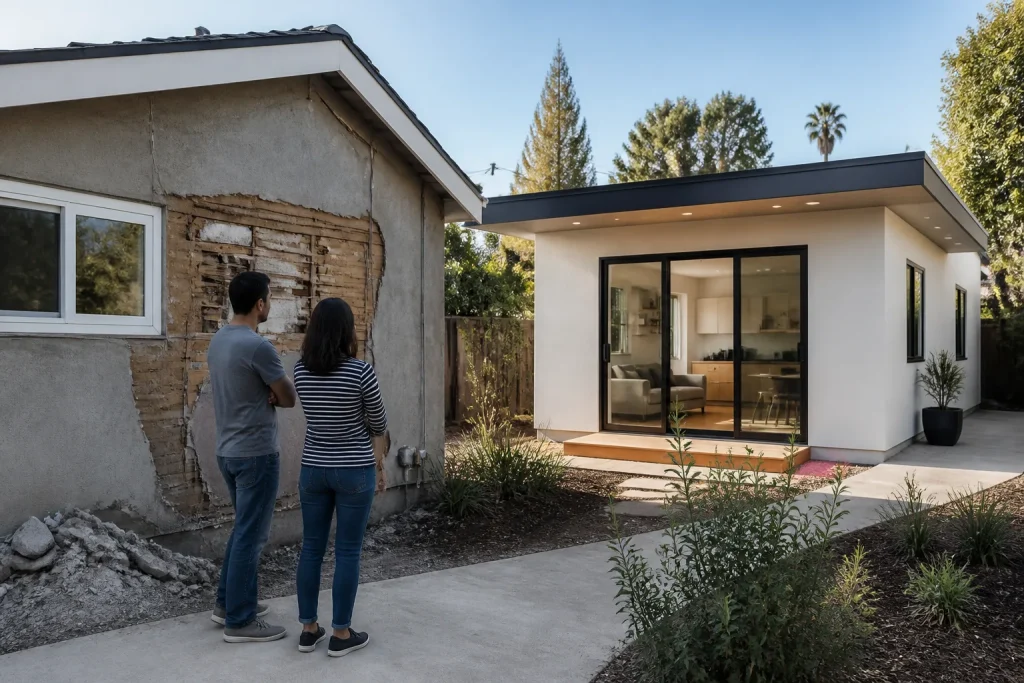
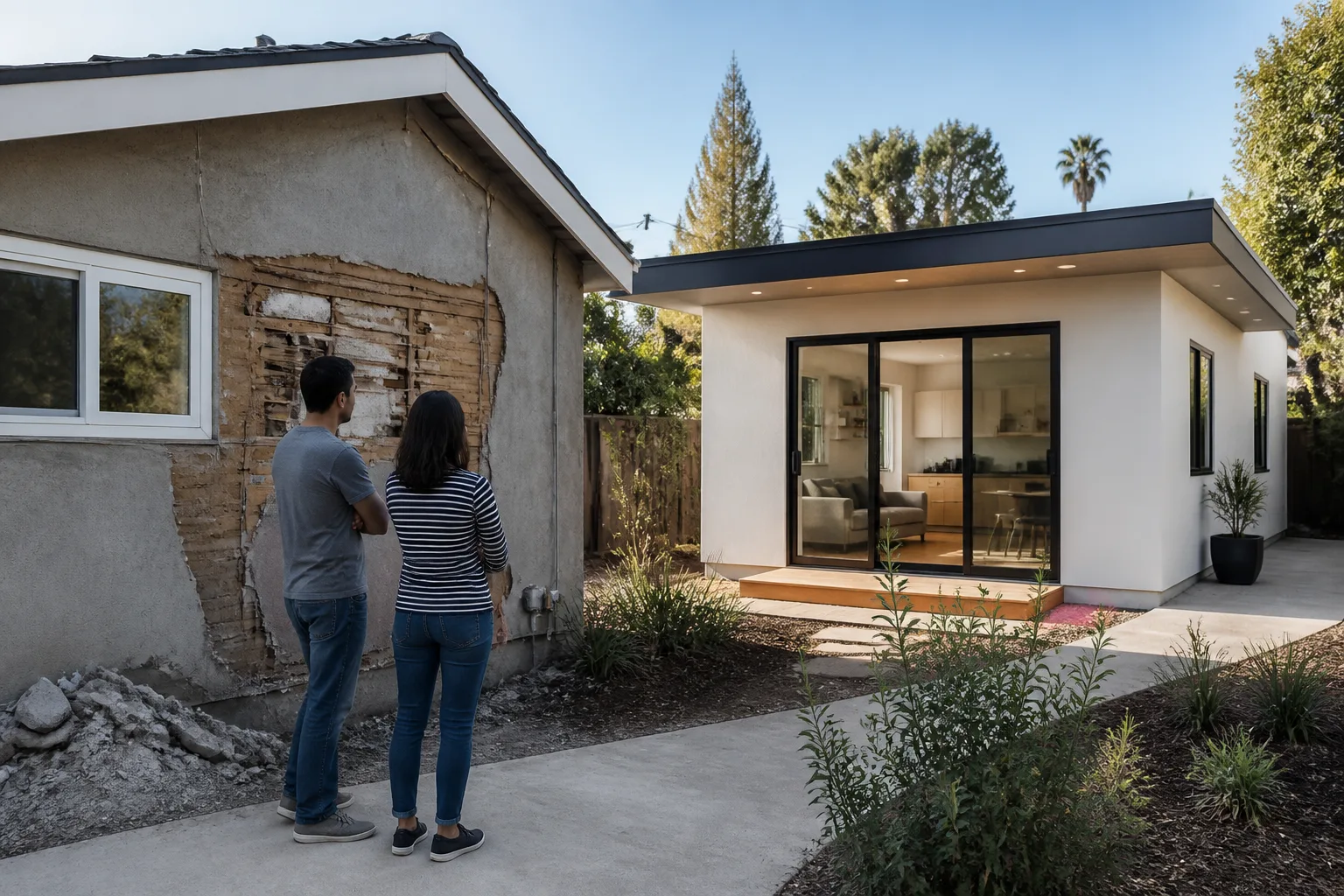
Most Los Angeles homeowners facing a beat-up garage or guesthouse start with the wrong question. They ask, “What will it cost to fix this?” The right question is, “What will it cost to get a legal, habitable ADU on this footprint, and does the existing structure help or hurt that number?” We’ve watched too many families sink $40,000 into repairing a non-permitted structure, only to learn during the permit process that the city treats it as new construction anyway. They paid for repairs on a building that, legally, didn’t exist. This guide walks through the decision framework we use with every client, so you can run the math before a contractor ever walks your lot.
Start With the Permit History, Not the Hammer
Before you call any ADU builder in Los Angeles, pull your property’s permit history. The Los Angeles Department of Building and Safety (LADBS) keeps records online, and you can request them yourself in about ten minutes. What you’re looking for is whether the existing structure, garage, guesthouse, pool house, or whatever stands on the lot today, has a certificate of occupancy and permits that match what’s actually built.
Here’s what we see regularly: a house in Van Nuys was built in 1952 with a permitted two-car garage. In 1987, someone converted that garage to a rec room, no permit. In 2005, someone else added a bathroom, also no permit. The family now living there calls it a guesthouse and wants an ADU. The permit history shows a garage. The bathroom doesn’t exist on paper. The rec room conversion doesn’t exist on paper. Under current Los Angeles ADU ordinance rules, that existing square footage may be treated as unpermitted space. That changes everything about the repair-versus-replace calculation, because the city will require you to bring the unpermitted work up to code before it counts toward anything.
If the permit history shows a clean, permitted structure, repair becomes a real option. If it shows a mismatch between what’s on paper and what’s standing, you’re likely looking at replacement, or at minimum, a partial teardown. This is the single most important piece of information in the whole decision, and most homeowners never check it before spending money on a contractor’s visit.
The Three-Part Cost Test
Once you know what the city actually recognizes on your lot, you can run the numbers. We use a three-part test with every Los Angeles homeowner trying to decide between repair and replacement:
- Structural repair estimate: What does it cost to bring the existing shell to a condition that can support a permitted ADU conversion? This includes foundation work, framing, roof structure, and any seismic or termite remediation. In Los Angeles, for a typical 400-square-foot detached garage in fair-to-poor condition, this number usually lands between $80,000 and $140,000 by the time you include new electrical, plumbing rough-in, insulation, drywall, windows, and finishes.
- New build estimate: What does it cost to remove the existing structure and build a new, code-compliant ADU on the same footprint? For the same 400 square feet, a site-built ADU in Los Angeles typically runs $180,000 to $260,000. A prefab or modular ADU from a manufacturer like Abodu, Cover, or Dvele can bring that down to $150,000 to $220,000 depending on site work, foundation type, and utility connections.
- Value difference: What does a legal, code-compliant ADU add to the property versus a patched-up non-permitted structure? A permitted ADU adds rental income potential and resale value that a non-permitted structure simply cannot. In Los Angeles, a legal one-bedroom ADU can rent for $1,800 to $2,400 a month depending on the neighborhood. That income stream, not the building’s condition, is the asset you’re actually deciding whether to buy.
The test isn’t “repair is cheaper.” The test is “which option gets me to a legal, rentable, valuable ADU for the lowest total cost per habitable square foot.” When repair costs hit 60% to 70% of replacement cost, replacement usually wins, because you’re inheriting an unknown foundation, unknown framing conditions, and a structure that wasn’t designed to current energy or seismic standards.
When Los Angeles Seismic Requirements Tip the Scale
Los Angeles has specific structural requirements that older buildings often fail on the first inspection. If your existing garage or guesthouse sits on an unbolted foundation, or if the walls lack adequate shear resistance, the retrofit work can be shockingly expensive in relation to the structure’s remaining value.
Here’s what we mean. A homeowner in Highland Park called us about converting a detached garage from the 1940s. On paper, it was permitted. In person, it had a perimeter foundation with no anchor bolts, no hold-downs, no plywood shear panels, and dry rot in three corners. The repair estimate to make that structure suitable for an ADU came to $92,000. The cost to demolish it and build a new ADU of the same size on a proper foundation? $148,000. But the repaired version would still be an 80-year-old building with an 80-year-old roof and an 80-year-old slab. The new version carries a manufacturer’s warranty and was engineered to current code from day one.
That math, roughly 62% of replacement cost, made the decision clear. We tore it down. And the family got a better building for the long run. The old garage wasn’t an asset. It was a liability the permit process was about to expose.
Older structures in Los Angeles, particularly those built before 1960, often require significant seismic retrofitting to meet current requirements for habitable space. Those requirements don’t apply the same way to a garage used for parking. The moment you convert it to living space, the structural bar rises. That’s why a garage that’s been “fine for parking” can suddenly need $30,000 in structural work the minute it becomes an ADU.
What a Real Site Assessment Should Include
An honest ADU builder’s site assessment in Los Angeles should take 60 to 90 minutes and should leave you with specific information, not just a handshake. Here’s what we cover when we walk a lot, and what you should expect from anyone you’re considering:
- Permit history review: The builder should ask about, or already have pulled, the property’s permit record. If they never mention permits or act like it’s a detail to figure out later, that’s a red flag.
- Structural observation: Foundation condition, wall and roof framing, signs of movement, water intrusion, termite damage. Not a full engineering report, but enough to know whether repair is even on the table.
- Utility mapping: Where sewer, water, gas, and electrical connect, and whether the existing structure has access to them or whether new trenching will be required. Trenching costs in Los Angeles can run $8,000 to $20,000 depending on distance and soil.
- Setback and zoning check: Whether the existing structure meets current ADU setback requirements, or whether its location on the lot creates a constraint that affects repair or replacement feasibility.
- Written findings: You should receive, in writing, what we observed, what we don’t know yet, and a clear next step. If a builder gives you a verbal estimate only and wants a deposit to go further, slow down.
Red flags that a builder is steering you toward a more expensive option without showing their math: vague references to “a lot of work involved,” no itemized breakdown, pressure to sign before you’ve seen permit history, and any estimate that doesn’t clearly separate repair costs from finish costs. A builder who can’t show you the line items doesn’t have a number. They have a guess with your name on it.
Repair vs. Replace: A Practical Decision Path
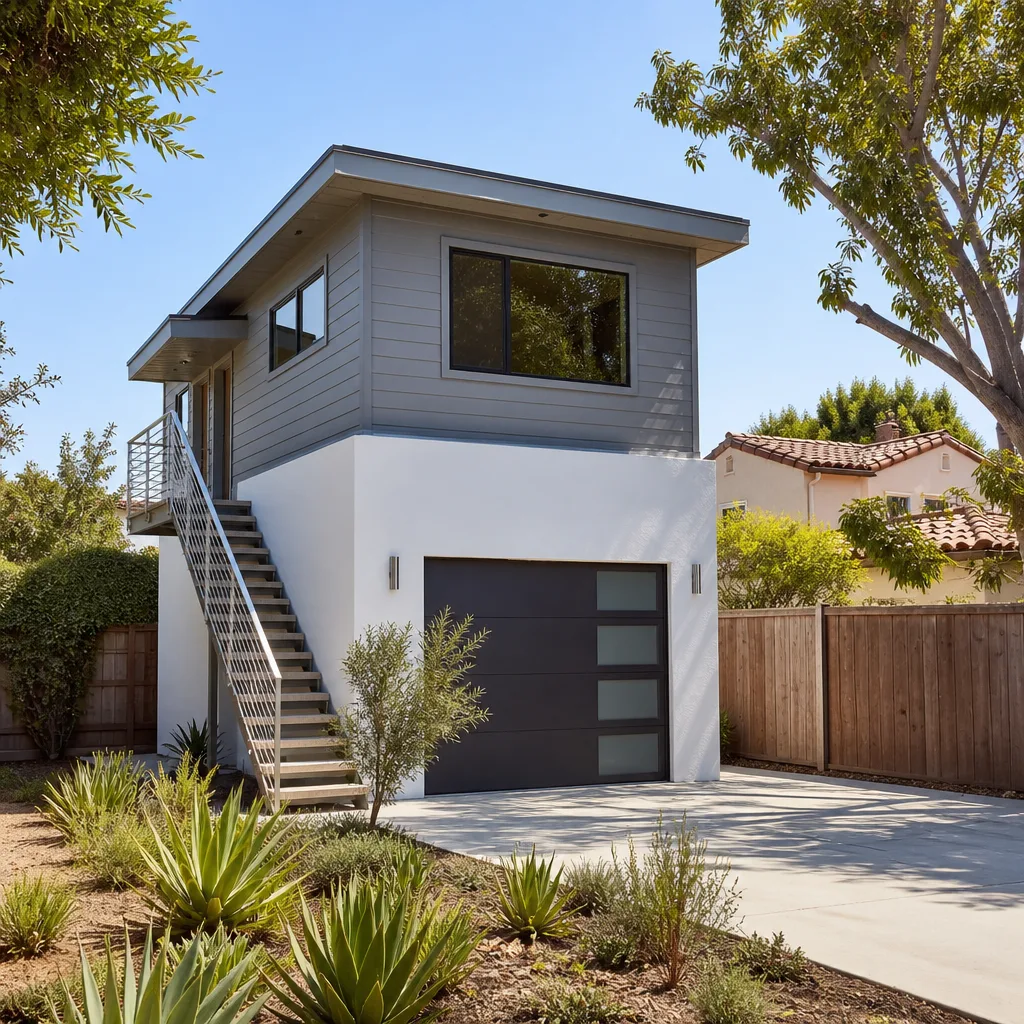
Here’s the decision path we give Los Angeles homeowners, in order:
- Pull the permit history. If the structure isn’t permitted, or the permits don’t match what’s built, treat it as unpermitted space. You’re likely looking at replacement or a significant correction process.
- Get a structural assessment. From a licensed contractor or structural engineer. Find out what it would take to make the existing shell legally habitable.
- Run the three-part cost test. If repair exceeds roughly 60 – 65% of replacement cost, replacement is usually the better long-term decision.
- Factor in what you actually want. A repaired 1940s garage converted to an ADU will never feel like a new home. A new ADU, built to current code with modern insulation, air sealing, and windows, feels like a new home on your lot. If you’re planning to live in it or rent it for decades, that difference matters.
- Choose a builder who shows their work. Written pricing before any work starts, a clear scope, and a promise in writing that the job will be done right. Those aren’t extras. They’re the baseline.
We pulled an old garage out of a lot in Mar Vista a few months back where the homeowner had already paid $18,000 for repairs before calling us. The garage had no permitted history, the repairs didn’t change the permit situation at all, and the structure still would not have passed an ADU inspection. That’s a hard phone call to make as a homeowner. But it was also the moment the decision became clear: stop repairing a building the city didn’t recognize, and start building one they would.
When to Call a Pro
If your permit history is confusing, if the existing structure shows signs of movement or water damage, or if you simply want an honest read on whether repair is even a realistic option, call a professional. In our experience, the conversation is worth more than any amount of online research, because the answer depends on your specific lot, your specific structure, and what the city has on file for your specific property.
At Seedling ADU Builders, we provide written pricing before any work begins, and every completed job is covered by our Done Right Promise. If it’s not done right, we make it right. That applies to every ADU, garage conversion, and home addition we build in Los Angeles. We also work directly with homeowners evaluating prefab and modular options from manufacturers like Abodu, Cover, Dvele, and Mighty Buildings, so the product you choose matches your lot and your budget, not just what we prefer to sell.
If you’re weighing repair versus replacement on an existing structure in Los Angeles, we’re happy to walk the lot and give you our honest assessment. Related services in Los Angeles: ADU Builders in Los Angeles, Garage Conversion Contractor in Los Angeles, and Home Addition Contractor in Los Angeles. You can also learn more about what we do at Seedling ADU Builders home.
The Bottom Line
The repair-versus-replace decision for an existing structure on your Los Angeles lot comes down to three things: what the city legally recognizes, what the structure actually needs to become habitable, and how those numbers compare to building new. Most homeowners skip step one. Don’t. Pull your permit history before you spend a dollar, get a structural read from someone who isn’t trying to sell you a teardown or a patch job, and run the numbers in writing. If you’re in Los Angeles and need help with that process, Seedling ADU Builders offers free estimates, call (707) 383-5338. We’ll help you decide whether that old structure should get a second life or a dignified goodbye, and you’ll know exactly what it costs before anything gets touched.
Frequently Asked Questions
Repairing a typical 400-square-foot Los Angeles garage to make it structurally suitable for an ADU conversion usually costs between $80,000 and $140,000, including foundation work, seismic retrofitting where needed, and electrical and plumbing rough-in. If the repair estimate exceeds roughly 60 – 65% of the cost to build new on the same footprint, replacement is typically the better financial decision. Call (707) 383-5338 for an exact quote, estimates are free.
Los Angeles does not allow you to simply convert non-permitted square footage into an ADU. The city treats unpermitted structures as new construction, meaning you’ll need to bring the work up to current code before it counts toward your ADU. In many cases, it is less expensive to remove and rebuild than to correct unpermitted work piece by piece. Call (707) 383-5338 and we’ll walk you through what your permit history shows.
Not necessarily for the initial decision. A qualified ADU builder who knows Los Angeles code requirements can often give you a clear read on whether repair is realistic, and then recommend a structural engineer only if the structure shows signs of significant movement, water damage, or foundation issues. What matters most is that you get the assessment in writing with specific findings.
A new ADU in Los Angeles typically takes 8 to 14 months from permit application to final inspection, depending on the manufacturer and site conditions. A garage conversion of a permitted structure can sometimes be completed in 6 to 10 months, but only if the existing shell passes structural review without major retrofit work. The repair-versus-replace decision directly affects both your timeline and your total cost.
Written by the team at Seedling ADU Builders.
Need ADU Help?
Call Seedling ADU Builders - licensed & insured, here with fast after-hours help in Los Angeles.
(707) 383-5338