
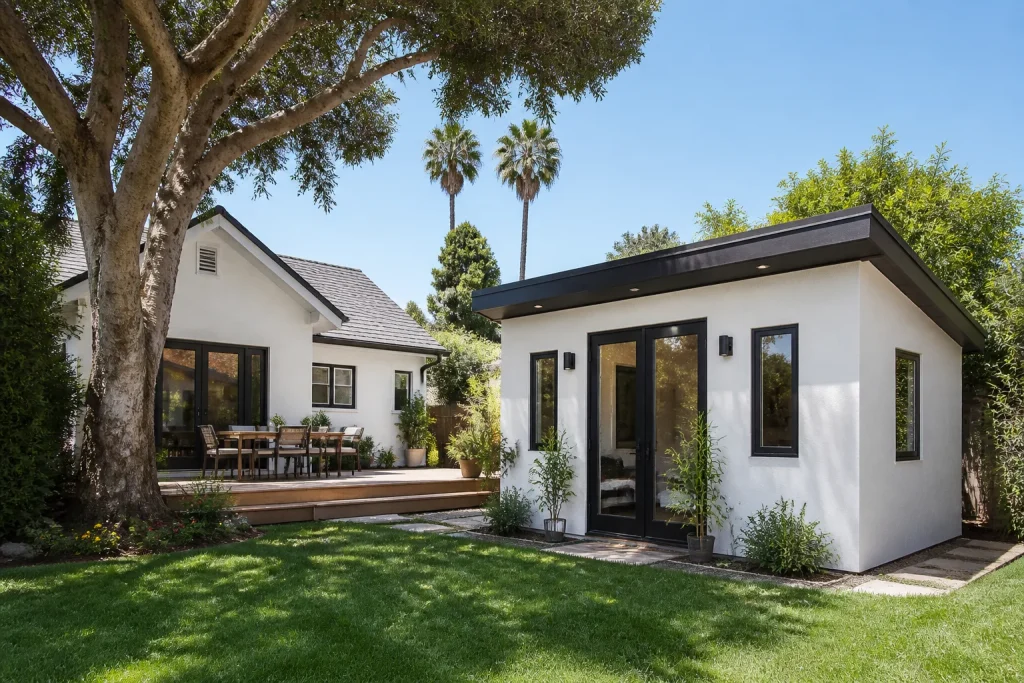
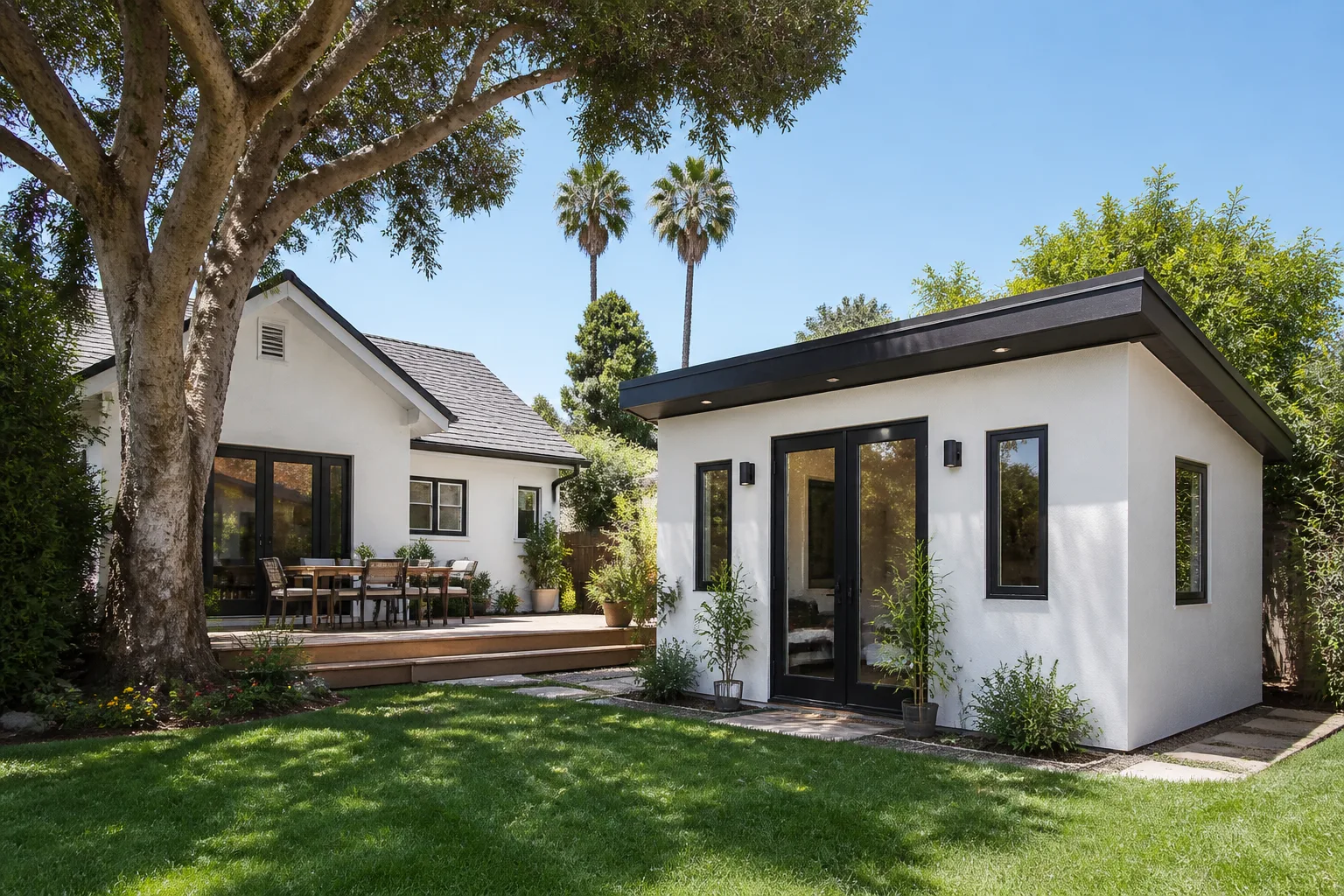
Mighty Buildings Home Addition Contractor in Los Angeles: A Homeowner’s Guide
Mighty Buildings is not a home addition contractor in the traditional sense. It’s a prefabricated ADU manufacturer, and a homeowner in Los Angeles generally works with a local contractor like Seedling ADU Builders to handle the site preparation, foundation, utility connections, and LADBS approvals that surround the factory-built unit. The panelized modules ship from a factory and go up quickly, but the calendar around them, including permits and site work, still takes the same weeks a site-built ADU does. Knowing where the factory work ends and the Los Angeles site work begins is the difference between a smooth project and an expensive misunderstanding. If you’d rather talk this through with a person instead of reading, call (707) 383-5338 and we’ll walk you through it.
We spend a lot of time explaining this exact distinction to homeowners in Los Angeles. A family will call us after seeing a time-lapse of a Mighty Buildings unit crane-lifted into place in a single afternoon, and they’re surprised to learn the driveway still needs a trench for the new gas line, the panel needs LADBS sign-off, and the foundation had to be poured six weeks earlier. The installation moment is real. It’s also only one day on a calendar that looks a lot like any other ADU project in Los Angeles.
What Mighty Buildings Actually Builds, and What It Doesn’t
Mighty Buildings manufactures ADU modules using a 3D-printed composite stone material for exterior walls and panelized components assembled in a factory. The factory produces the shell, insulation, windows, doors, and many interior finishes. What the factory does not produce is the foundation under the unit, the trench for water and sewer, the electrical service upgrade, the site drainage, or the final LADBS inspection. Those are site-work phases, and they belong to a local contractor working in Los Angeles, not to the factory in Monterrey or the design team in Oakland.
When you buy a Mighty Buildings unit, you are buying the module. You are not buying a finished, permitted, move-in-ready home at the moment of purchase. The path from “module delivered” to “grandma moved in” includes:
- Site survey and soil report for the Los Angeles lot
- LADBS plan check for the ADU, including any zoning overlays specific to your neighborhood
- Foundation work, usually a slab or pier system engineered for the module’s point loads
- Utility trenching and connections, which in older Los Angeles neighborhoods often means upgrading a 100-amp panel to 200 amps
- Crane placement or set crew on delivery day
- Final connections, stucco or siding transitions at the module seams, and interior trim work
- LADBS final inspection and certificate of occupancy
None of that is a knock on Mighty Buildings. It’s the same list for Abodu, Cover, Dvele, or any other prefab ADU you might be comparing. The factory model compresses the framing and finishing phase. It does not compress the ground. And in Los Angeles, the ground is where surprises live: old cast-iron sewer lines, undersized gas meters, sloping lots in Echo Park or Mount Washington that need retaining walls before a module ever shows up.
Mighty Buildings Timeline in Los Angeles: The Honest Calendar
A Mighty Buildings ADU in Los Angeles typically takes four to seven months from signed contract to move-in, assuming the lot is reasonably flat, the sewer line is in usable condition, and LADBS moves without major corrections. A site-built ADU with a good Los Angeles crew runs about the same, sometimes a month longer. The factory saves time on framing, drywall, and interior finishes. It does not save time on permits, and it does not save time on utility work, and it does not save time when the LADBS reviewer asks for a soils report revision in week five.
We’ve seen the disappointment that happens when a homeowner budgets for the eight-week factory lead time and forgets the six to eight weeks of LADBS plan check before the factory even starts. In Los Angeles, the permitting queue does not care whether your ADU is factory-built or stick-built. The city reviews structural calcs, setbacks, and utility drawings the same way. A prefab submittal can go slightly faster because the State of California has pre-approved certain factory-built housing through the Department of Housing and Community Development, which reduces some local structural review. But that benefit is at the state level. The local planning review for height, setbacks, and parking in Los Angeles still happens, and it still takes weeks.
Here is a realistic Los Angeles timeline for a Mighty Buildings project we’d quote:
- Weeks 1 – 3: site assessment, survey, and preliminary design fit
- Weeks 3 – 9: LADBS permit submittal and plan check
- Weeks 9 – 11: foundation and site work begin once permits issue
- Weeks 11 – 18: factory fabrication of the module, running parallel to site work
- Week 18 or so: delivery and set; crane day
- Weeks 19 – 23: utility connections, interior finish-out, LADBS inspections
That’s the honest calendar. The dramatic one-day install is real. The five months around it are also real. For some Los Angeles lots, especially those in the hills or with complicated sewer runs, site-built can actually finish faster because a good framing crew can work around site complications a factory module cannot.
Design Constraints: What the Factory Fixes, What the Lot Decides
Mighty Buildings offers a set of floor plans with limited customization: you choose the model, the elevation, the finish package, and some layout options within a defined envelope. You do not get unlimited window placement, unlimited ceiling heights, or a custom roofline to match a 1920s Spanish Revival in Los Feliz. The factory model depends on repeatable engineering. Every custom change requires re-engineering, and re-engineering eats the schedule savings the factory created.
That trade-off works beautifully for a homeowner who wants a clean, modern one-bedroom ADU on a standard flat lot in the San Fernando Valley. It works less well for a homeowner with a 40-foot-wide lot in Silver Lake where the ADU has to tuck behind an existing garage with a 5-foot side yard and a protected oak tree at the property line. In Los Angeles, the lot constraints often drive more of the design than the homeowner expects, and a factory module that cannot shift two feet to the left can send you back to the drawing board.
We’ve helped Los Angeles homeowners think through this with a simple test: if you can live with the factory’s floor plan as drawn, prefab saves you time and money. If you need the ADU to respond to an odd lot, an existing structure, or a view corridor, a site-built or hybrid approach gives you the flexibility the factory cannot.
Permitting a Prefab ADU in Los Angeles vs. a Traditional Plan Check
Los Angeles accepts prefabricated ADU submittals through the same LADBS portal as site-built projects, with one difference. Factory-built units that carry HUD or California HCD certification can bypass some local structural plan check because the state has already reviewed the module’s engineering. The local review then focuses on the site: foundation design, grading, drainage, utility connections, and zoning compliance. That can trim a few weeks off the structural review, but it does not skip the review entirely.
The zoning review in Los Angeles is the part nobody escapes. Setbacks, lot coverage, height limits, parking requirements for ADUs (often waived or reduced under state law, but local overlays still apply), and historic district rules in areas like Hancock Park or Angelino Heights all get reviewed regardless of whether the walls were printed in a factory or framed on-site. If you’re adding a garage conversion in Los Angeles alongside a new prefab ADU, both applications run through the same LADBS office and the same inspector. The garage conversion does not get a shortcut because the ADU is prefab.
One practical point we make with every Los Angeles client: find out early whether your lot is in a hillside grading area, a liquefaction zone, or a methane zone. Los Angeles has specific geotechnical requirements in each, and a Mighty Buildings module still needs a foundation engineered for those conditions. The factory does not make the soil less complicated.
How to Compare a Prefab ADU Against a Local Builder: The Questions That Matter
The right question is not “which is better.” The right question is “which fits my lot, my budget, and my tolerance for unknowns.” A Mighty Buildings ADU on a flat, open lot in Northridge with a 200-amp panel already in place is a strong candidate. The same unit on a hillside in Echo Park with a 60-amp panel, a shared sewer lateral, and a 10-foot retaining wall is a different conversation.
We tell Los Angeles homeowners to ask these questions of any prefab manufacturer or the local contractor representing them:
- What is included in the published module price, and what is site work? A module price that looks like $180,000 can become $260,000 after foundation, utilities, crane, and fees. Written pricing before work starts is the only way to compare honestly.
- Who pulls the permits and who is the contractor of record on the LADBS permit? In Los Angeles, the party named on the permit is the party responsible to the city. Make sure that party is licensed and has done this before in Los Angeles.
- What happens if the module arrives damaged or the crane cannot reach the set location? These are real risks on tight Los Angeles lots. The answer should be specific, not a customer service phone number.
- What is the warranty on the factory module, and who performs the warranty work in Los Angeles? A factory in Northern California or Mexico cannot send a repair team to your ADU in Westchester. A local contractor can.
- Will the price change between the first quote and the first day of work? The answer should be no, in writing, before any contract is signed.
We pulled a Mighty Buildings unit out of a garage over in Atwater Village last fall, actually. The homeowner had ordered it through a sales rep who quoted the module cost and nothing else. By the time the site work was priced, the project no longer penciled, and the module sat wrapped in plastic while everyone argued about who owed what. That is not a Mighty Buildings problem. It is a process problem, and it is entirely avoidable with a written scope that separates factory work from site work before anyone signs.
When to Call a Professional, and What to Expect
If your Los Angeles lot has any of the following, call a licensed local contractor before you fall in love with a factory floor plan: a slope over 10 percent, a sewer lateral older than 1970, an electrical panel under 100 amps, a historic district overlay, a protected tree anywhere near the build area, or a shared driveway. Each of these adds time and money to a prefab project, and none of them shows up in the factory brochure.
Related services in Los Angeles: if the ADU is going over or next to an existing garage, our Garage Conversion Contractor in Los Angeles team handles the permitting and build-out. If you’re comparing a full addition to an ADU, see our Home Addition Contractor in Los Angeles page for how the cost and timeline shift. And if you’re still deciding between prefab and site-built for an ADU, our ADU Builders in Los Angeles page walks through the local process step by step.
The Bottom Line
Mighty Buildings makes a factory-built ADU module that can shorten the framing and finishing phase of a Los Angeles project. It does not shorten the permitting, the foundation, the utilities, or the LADBS inspection. For the right lot, a prefab ADU from Mighty Buildings or a comparable brand like Abodu, Cover, or Dvele is a smart, cost-competitive choice. For the wrong lot, it can become an expensive box sitting in a driveway. The homeowner’s job is to know which lot they have before they buy. If you’re in Los Angeles and want help sorting through the options, Seedling ADU Builders offers free estimates, written pricing before any work starts, and a 365-Day Done Right Promise on every project. Call (707) 383-5338 and we’ll help you figure out what fits.
Frequently Asked Questions
A Mighty Buildings ADU in Los Angeles typically lands between $180,000 and $280,000 all-in, including the module, foundation, site work, utilities, and permits. The module itself can run $100,000 to $160,000 depending on size and finishes, but site work in Los Angeles consistently adds $60,000 to $120,000. We provide a written price before any work starts so the number you see is the number you pay. Call (707) 383-5338 for an exact quote on your specific lot.
Sometimes, but not by as much as the marketing suggests. A prefab ADU saves the framing and interior finish weeks, but the LADBS permitting, foundation, and utility work take the same time as a site-built project. In Los Angeles, most prefab ADUs finish in four to seven months, while site-built ADUs run five to eight months. The bigger variable is usually the lot, not the building method.
Yes. We are the contractor of record on the LADBS permit, which means we handle the submittal, respond to plan check comments, schedule inspections, and own the final certificate of occupancy. The homeowner is never left to navigate the city alone. Our name is on the permit, and our crew is on the lot.
No. Every Seedling project receives a written price before any work begins, and we do not add surprise line items after the crew arrives. If site conditions change in a way nobody could have known about before excavation, we discuss it before we touch anything, and the homeowner approves any adjustment in writing first. The price you sign is the price you plan around.
Written by Ben Ortega, Owner at Seedling ADU Builders, serving Los Angeles since 2001.
Need ADU Help?
Call Seedling ADU Builders - licensed & insured, here with fast after-hours help in Los Angeles.
(707) 383-5338