
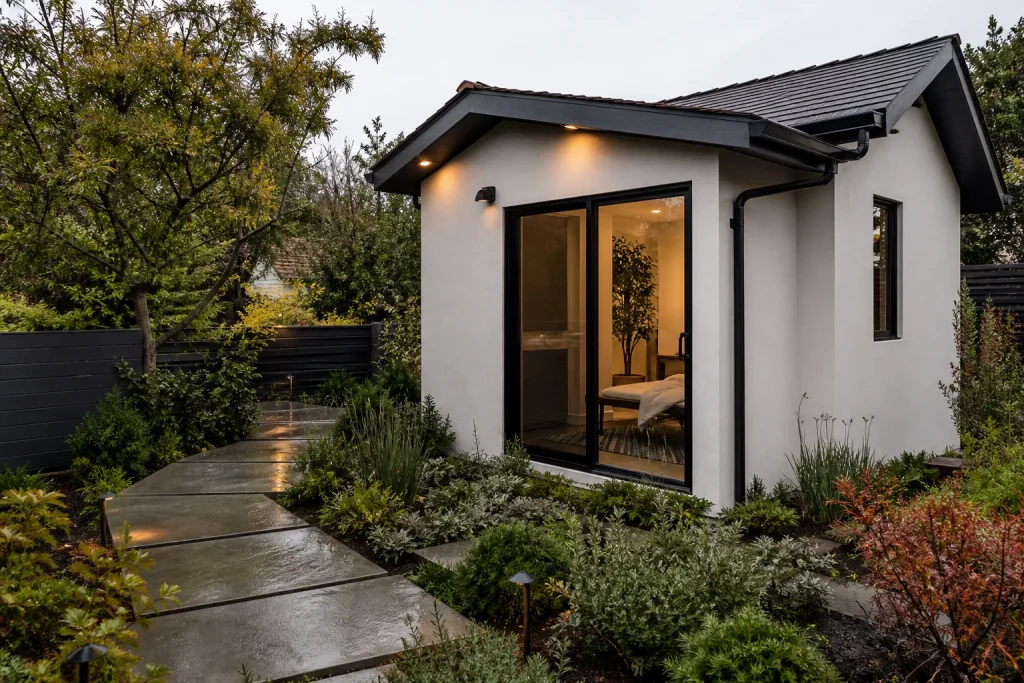
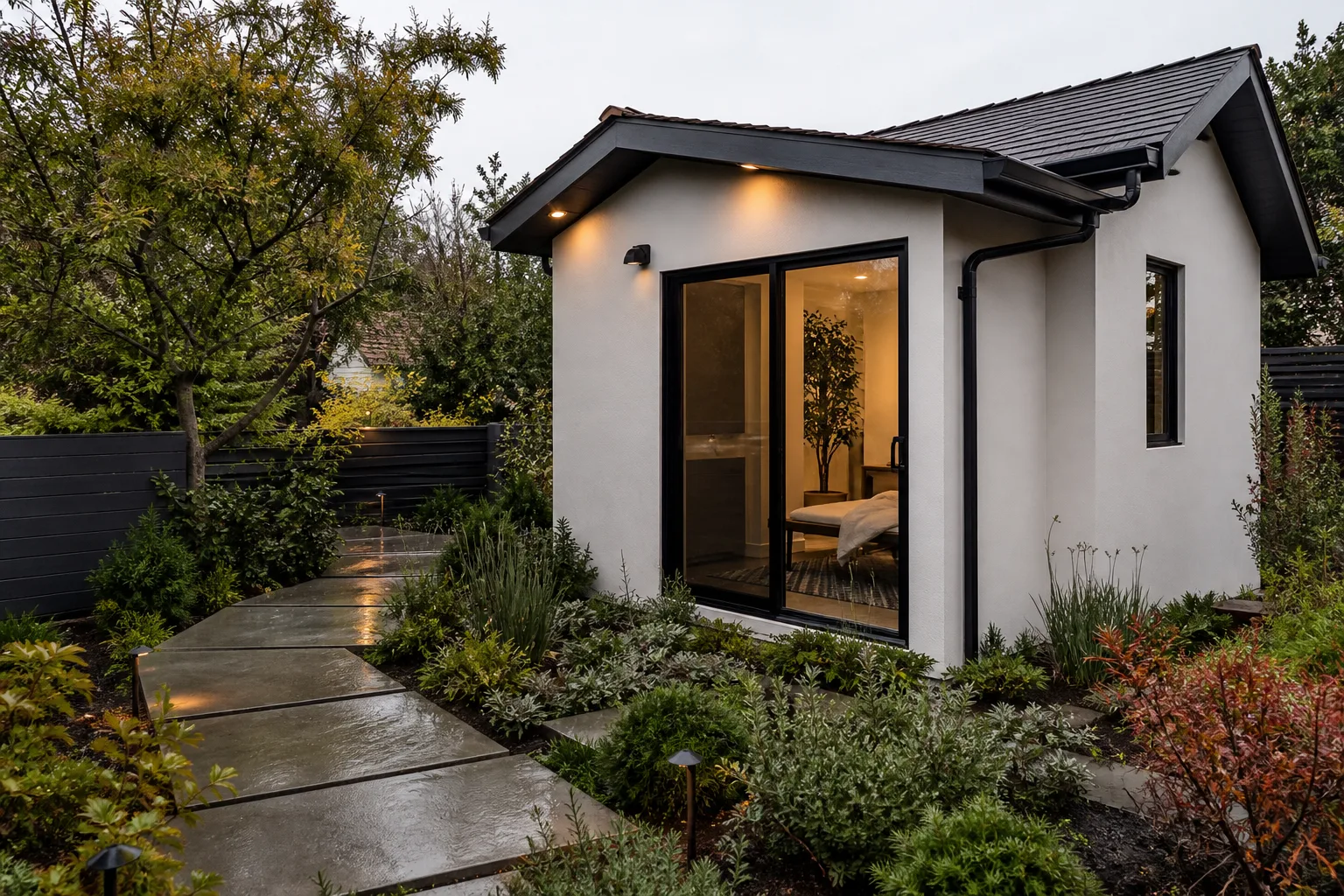
Preparing Your Home’s ADU for Winter in Los Angeles
Preparing an ADU for winter in Los Angeles means checking eight specific points: roof penetrations, window and door seals, sliding door tracks, drainage grading, mini-split filters and drain pans, caulk and flashing joints, water heater and shutoff valves, and the area under the unit. Most of these take under an hour each, and they’re what stands between a dry winter and a water-damage bill that runs $4,000 to $6,000. If you’d rather not climb onto the roof or crawl under the slab, call (707) 383-5338 and we’ll send someone who will.
LA gets roughly 14 inches of rain in an average year, but it rarely arrives as gentle, all-day drizzle. It comes in concentrated storms after months of dry heat, and that pattern beats on window seals, roof flashing, and exterior caulk differently than a steady-rain climate does. ADUs take this harder than main houses because they’re smaller, which means more roof penetrations per square foot: a bathroom vent, a mini-split line set, a range hood, maybe two plumbing vents, and often a skylight, all crossing a compact roof plane.
A $200 fix in October becomes a $6,000 repair in February if water gets behind the siding or under the slab. What follows is the checklist we walk through when we inspect an ADU before the rainy season, laid out so you can do it yourself if you want to.
Start with the roof penetrations: vents, line sets, and the tiny holes nobody thinks about
Every pipe, vent, and electrical conduit that pokes through an ADU roof is a potential water entry point. In a small unit, there are more of these per square foot than in a main house, so they deserve more attention, not less. The first thing to check is the rubber boot around each plumbing vent. After a Los Angeles summer of 90-degree days and direct sun, rubber boots dry out and crack at the base where they meet the pipe. Run your finger around the seal. If it feels brittle or leaves black residue on your hand, replace it now. The boot itself costs about $15 to $30 at any hardware store in Los Angeles.
Mini-split line sets are the second one. These are the two copper pipes and a bundle of wires that run from the outdoor condenser to the indoor wall unit. Where they pass through the wall or roof, the penetration is sealed with caulk or a rubber gasket. Check for gaps, dried caulk, or daylight visible through the hole. During late fall, we see more failures at this spot than anywhere else on ADUs, because the sealant dries through the summer and then heavy rain pushes water along the line set into the wall cavity. A tube of exterior-grade polyurethane caulk is under $12, and it fixes most early-stage failures.
The third penetration most people miss is recessed or surface-mounted light fixtures on the ceiling. If the ADU has recessed lights, especially in a bathroom or exterior soffit, check that the trim isn’t warped and the housing seal is intact. Condensation forms in unsealed housings during cold nights, and over a winter that leads to rust, shorts, or a drip that looks exactly like a roof leak but isn’t one.
Sliding door tracks: the overlooked drainage system
Most ADUs in Los Angeles have at least one sliding glass door, and every sliding door track has small weep holes near the bottom outside edge. Those holes let rainwater drain out of the track instead of pooling and spilling over into the room. After ten months of dry weather, they fill with dust, pet hair, dead leaves, and the fine particles that settle on everything in LA. In our experience, the number one cause of winter water intrusion in newer ADUs is a sliding door track with plugged weep holes and a layer of debris holding standing water.
Cleaning this takes ten minutes. Open the door, sweep the lower track with a stiff brush, and pour a cup of water into the outside track. Watch where the water goes. If it pools and stays, the weep holes are blocked and need to be cleared with a thin, flexible wire or a blast of compressed air. If the water drains but the interior side of the track feels damp, the door’s weatherstripping is worn and you’ll want to replace the gasket before the first significant storm. Door gasket material is under $20 at most Los Angeles hardware stores.
Don’t wait until after the first rain. Once the track fills with silt, the water can’t drain, and it backs up under the door sill into the flooring. Tile with a cement backer can survive one storm. Engineered wood or laminate won’t. We’ve pulled flooring out of an ADU over by Atwater Village where a plugged sliding door track had been leaking for weeks without anyone noticing, because the water was wicking under the flooring from the edge.
Caulk, flashing, and why LA’s temperature swings break seals faster than freezing does
Los Angeles doesn’t freeze, but it swings 30 degrees between the low at night and the high in the afternoon, and it does that for months straight. Building materials expand and contract with every cycle, and exterior caulk is the material that takes the brunt of it. In a stable climate, exterior caulk might last five to seven years. In Los Angeles, it’s more like three to five, and shorter on south and west facing walls that catch full afternoon sun.
Walk around the outside of the ADU and look at every joint where the siding meets a window frame, a door frame, an exterior outlet box, or a hose bib. Look for cracks running through the caulk bead, gaps where the bead has pulled away from one surface, or chalky texture that rubs off on your finger. If you see it, remove the old bead and apply fresh exterior caulk rated for UV exposure. It takes a few minutes per window and a tube of caulk is around $10.
Flashing is the metal strip at roof intersections and around skylights. In Los Angeles, flashing failure usually shows up as a small rust stain or a lifted edge where the metal meets the roof. If you see a gap, don’t wait for a leak to confirm it. Check flashing now. If you see water staining inside the ceiling after it rains, the leak is already active and you’re no longer in prevention territory.
Drainage and grading: check the ground after the dry season compresses it
Los Angeles soil is largely clay and decomposed granite, both of which shrink when they dry out. After seven or eight months with almost no rain, the soil around an ADU’s foundation has pulled away from the concrete in many cases, leaving a shallow gap. When rain returns, water runs straight down that gap and pools against the foundation, which is exactly where you don’t want it.
The fix is simple: walk around the ADU and look at where the soil meets the foundation. The grade should slope away from the building for at least five feet, dropping about one inch per foot. If the soil has pulled back from the concrete, pack fresh soil into the gap and re-grade the first few feet so water sheds away. If the ADU has a concrete walkway or patio against the foundation, check that the slab hasn’t settled and is still sloped away from the unit. Over time, concrete settles too, and an apron that slopes toward the house funnels water right to the wall.
For ADUs with a crawl space, this is also the time to check the subfloor vents. They should be open in Los Angeles winters, because winter humidity is higher than summer and trapped moisture under the floor leads to musty smells and eventually to subfloor rot. Clear any leaves, grass, or stored boxes that block airflow. If the ADU has no crawl space but sits on a slab, drainage and grading around the slab are the whole drainage system, so make it a priority.
If you’re building an ADU soon, this is one reason we specify ground preparation details before construction starts. A well-graded site drains itself. A poorly graded one fights every rainstorm. If you’re in Los Angeles and planning a new unit, the ADU Builders in Los Angeles page explains what we check before a foundation is ever poured.
Mini-split and ductless HVAC: the fall dust season quietly clogs everything
By late October, Los Angeles air has spent months carrying fine dust, ash, and the dry particles that settle on every horizontal surface. Inside a ductless mini-split, that dust collects on two parts: the air filter in the wall unit and the condensate drain pan under the coil. A clogged filter makes the unit work harder and pushes up your winter heating bill. A clogged drain pan is worse: water backs up and drips down the wall, staining paint and damaging drywall.
Check the filter first. Most mini-split wall units have a front panel that lifts open. Take out the filter, rinse it under running water, let it dry completely, and put it back. If it’s torn or disintegrating, replacements are available for $20 to $40 depending on the brand and size. Doing this in late October and again in January keeps the unit working at full capacity through the coldest part of the year.
The drain pan is less obvious. On most units, it’s behind the coil and hard to see without tools, but you can tell if it’s clogged: water will drip from the unit or a small puddle will form on the floor beneath it. If you see that, turn the unit off and call a licensed HVAC person or our team. Don’t pour chemical drain cleaner into a mini-split drain line. It damages the pan. A clean filter goes a long way toward preventing the problem in the first place.
Los Angeles nights drop into the 40s in January and February, and a mini-split trying to heat a room through a clogged filter runs constantly and still doesn’t warm the space. If the unit is under three years old and struggling, the filter is the first thing to check.
If the ADU is rented: give the tenant a written winterization checklist
The hardest part of maintaining a rented ADU in Los Angeles is that small problems get ignored because the tenant doesn’t know they matter. A tenant won’t think to report a sliding door track full of leaves or a bathroom vent cover with rust around the edges. A written checklist changes that, because it tells them exactly what to look for and makes reporting simple.
Here’s a one-page checklist you can copy and hand to your tenant:
- Once a month from November through March, sweep the track of the sliding glass door and check that water drains after it rains.
- Check under each window after any rain heavier than a light drizzle. If the sill or wall below feels damp, report it.
- Look at ceilings under any roof vent, skylight, or recessed light after storms. Stains or drips should be reported immediately.
- Clean the mini-split filter every 30 days during winter (or according to the manufacturer’s schedule).
- Report any door or window that’s hard to close, any room that smells musty, or any outdoor wall outlet that trips.
The point of the checklist isn’t to make the tenant do maintenance for you. It’s to catch problems before they become structural. A tenant who knows what a water stain behind a mini-split means will tell you about it in November, when it’s a $300 fix, not in February, when you’re cutting open drywall and running a dehumidifier for a week.
When to call a pro
Most of what’s on this list is a reasonable Saturday morning’s work. But there are points where it’s better to let someone with a ladder, experience, and a license take over. If you’re not comfortable being on the ADU’s roof, call someone who is. Roof work is genuinely dangerous, and the savings from not hiring a pro disappear in a hurry when an emergency room visit is involved. If you see water staining inside the unit, active dripping, or mold, don’t attempt to trace it through walls and ceilings yourself. You need someone to find the source, open the wall, dry it out, and repair the interior, because trapped moisture inside a Los Angeles ADU wall will grow mold within days of a leak.
At Seedling ADU Builders, we inspect units like this all through October and November. Every visit starts with the same two things: shoe covers at the door and a written scope of what we’ll check. No ladder goes up before we’ve walked the property with the homeowner and talked through what we’re looking at. That’s part of the Cedarwell Care Promise the local pros work under, and it applies to a maintenance visit the same way it applies to a full build. The related work we do here in Los Angeles is covered on our Seedling ADU Builders home page, including Garage Conversion Contractor in Los Angeles services and Home Addition Contractor in Los Angeles work if you’re thinking beyond the current footprint.
If you want to do some of the work yourself, the brands we recommend to ADU owners in Los Angeles reflect what we see hold up best in the local climate. James Hardie siding and trim handles LA’s UV and temperature swings better than traditional wood products, and it’s a material we use on most of the units we build and renovate. Tuff Shed structures, which some Los Angeles homeowners use as the base for an ADU conversion, come with roof and wall assemblies that need the same pre-winter checks described above. And for homeowners in the research phase, prefab ADU companies like Abodu and Cover produce units engineered for California climates, though every prefab unit still needs a local site inspection before the first winter rain.
The Bottom Line
Los Angeles winters flood ADUs, but not because the rain is extreme. It’s because the dry season quietly degrades seals, caulk, flashing, and drainage, and the first real storm finds every weak point at once. Spending two hours checking the eight items above, then fixing what’s loose or cracked for under $100, prevents most winter-related ADU damage. Skip the check and you’re gambling $6,000 on a roof boot that costs $15 to replace.
If you’re in Los Angeles and you’d rather have someone else do the inspection, fix the problems, or walk you through what you’re seeing, Seedling ADU Builders offers free estimates on maintenance and repair work, and on full ADU construction and conversion projects. Call (707) 383-5338 and you’ll speak with a live person who can schedule a visit. No voicemail trees, no callbacks at the end of the day. Just a time to come out and look.
Frequently Asked Questions
A DIY winterization pass costs under $100 if all you need is caulk, a new roof boot, and a door gasket. Hiring a professional to inspect and do light maintenance typically runs $250 to $600 depending on roof access, size of the unit, and what needs replacing. Repairs found during the inspection, like a leaking skylight or rotted flashing, add to that, so getting the inspection in October gives you a real number before storm season. Call (707) 383-5338 for an exact quote on your ADU, and estimates are free.
The right time is late September through early November, after the summer heat has done its damage and before the first significant rain of the season. Waiting until December is workable but riskier, because the first atmospheric river can arrive with little warning. If you’re maintaining a rental ADU, get the tenant checklist in hand by mid-October so they know what to watch for when rain starts. The cost doesn’t change, but the stress level of doing it after a leak starts is much higher.
Units under five years old most often fail at three points: the rubber boot around roof plumbing vents, the caulk around mini-split line set penetrations, and the weep holes in sliding glass door tracks. All three are caused by the same pattern, which is a long, hot, dry Los Angeles summer followed by sudden heavy rain. Fixing all three before winter costs about $50 in materials. Fixing the water damage they cause can run several thousand dollars, especially if a leak reaches flooring or insulation.
Most of the checklist is safe for a homeowner: cleaning sliding door tracks, checking and replacing caulk, cleaning mini-split filters, and checking drainage slope around the slab. The exception is roof work. Walking on an ADU roof to check flashing, boots, and skylights carries real fall risk, especially on a wet morning, and it’s worth paying a professional who carries proper fall protection. If you see signs of an active leak, that’s also a pro call, because you need someone who can safely open the wall, dry the cavity, and repair the source. For our part, call (707) 383-5338 and we’ll tell you honestly what you can handle yourself and what you shouldn’t.
Written by the team at Seedling ADU Builders.
Need ADU Help?
Call Seedling ADU Builders - licensed & insured, here with fast after-hours help in Los Angeles.
(707) 383-5338